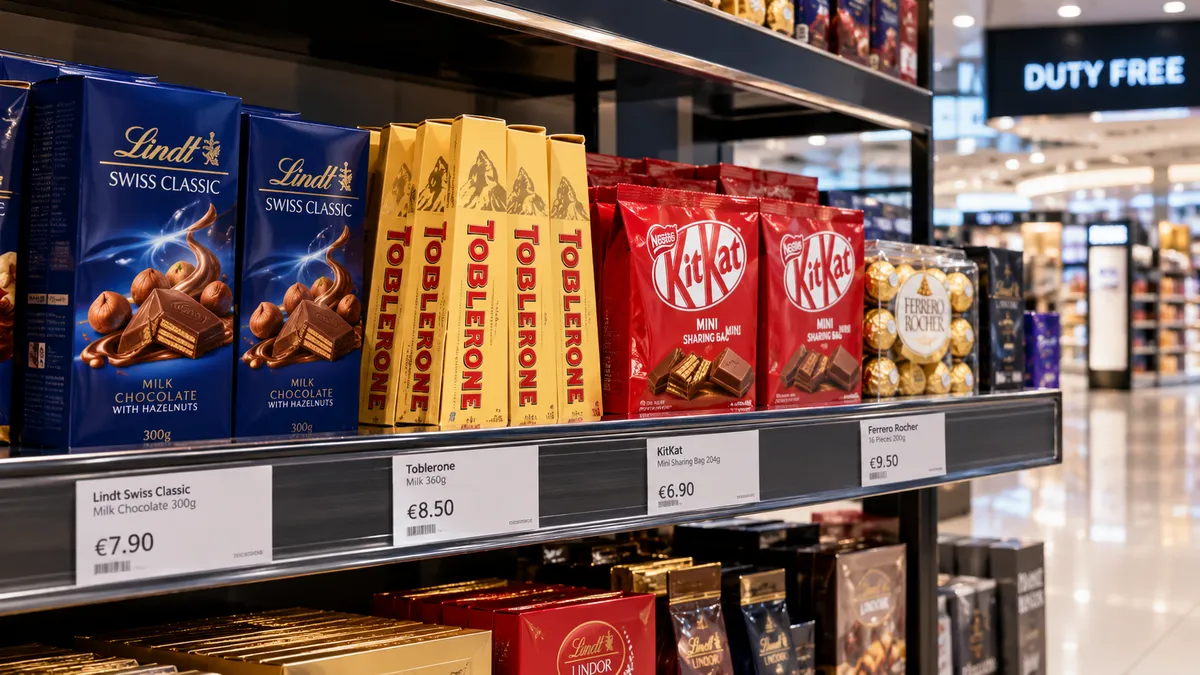

One of the clearest messages to emerge from Cannes was that travel retail needs to do more to convert the shoppers already entering its stores. Yet while the industry debates how to attract new customers and create more compelling experiences, some of the biggest commercial opportunities may lie in fixing the fundamentals — and pricing is one of them.
Across global travel retail, the same products can carry dramatically different prices between airports, while competing products can sit at inconsistent price points. Some variation is justified, but when pricing differences cannot be explained by market conditions or commercial strategy, brands risk losing both revenue and conversion. This raises the question of whether pricing is being managed strategically enough.
Shelftrak's store-level analysis reveals how underpricing, overpricing and poorly structured price ladders can create measurable commercial opportunities. Through its Perfect Store framework, Shelftrak measures actual execution against defined standards, identifying where pricing falls short and the potential Size of the Prize available from correcting it.
Separating strategy from drift
Price differentiation itself isn't the problem. Market regulations, supply chain costs and tax structures all create legitimate reasons for the same product to carry different prices in different markets. The problem is variation that cannot be clearly explained.
Within Europe's travel retail confectionery industry, Shelftrak's data routinely finds significant price variation between markets. Lindt Napolitains Assorted 500g, for example, was priced at $25.49 across the Spanish airports audited, compared with $40.41 in Geneva — a difference of over 58% for the same product.
Variation on this scale raises two questions: how much reflects legitimate market differences, and how much is pricing drift? And, importantly, what is the commercial opportunity available from correcting it?
Shelftrak benchmarks individual SKUs against their competitive set and regional averages, helping distinguish intentional pricing decisions from potential execution gaps. This exposes two opposite problems: products priced too low, potentially leaving value unclaimed, and products priced too high, potentially losing shoppers at the shelf.
Underpricing: value left unclaimed
The KitKat Mini Sharing Bag at London Heathrow provides one example. Shelftrak's benchmarking found it priced at £8.99, with comparable confectionery sharing products selling for up to twice as much per gram.
While differences in brand positioning and product characteristics may justify some of this variation, such a gap raises an important question about whether the product is capturing its full commercial value. But the real opportunity comes from understanding how widely underpricing is replicated — and what correcting it could be worth.
In one recent Shelftrak analysis for a major spirits brand, 4,532 facings were found associated with prices below the retailer's own benchmark, representing a modelled $307,000 pricing opportunity from correcting execution.
That changes the conversation considerably. Underpricing is no longer simply an observation about an individual shelf. It becomes a measurable commercial opportunity.
Rather than simply reporting where pricing falls short, Shelftrak can quantify the potential value available from correcting it, helping brands prioritise where to act.
Overpricing: when price becomes a barrier
The opposite problem matters too. When a product sits above its competitive set without a clear point of difference to justify the premium, price can become a barrier to conversion.
For travellers comparing products on the shelf, the difference between two similar offerings may be difficult to justify, particularly when the more expensive option offers no obvious additional value. In these circumstances, pricing risks pushing shoppers towards a competitor or discouraging a purchase altogether.
But this cannot be solved simply by identifying the highest-priced products and reducing them. A premium price may be entirely appropriate for a product's intended positioning. The important question is whether that price is justified by its competitive set, market and role within the category.
Shelftrak's Perfect Store approach provides a defined standard against which actual pricing can be measured, helping brands distinguish intentional positioning from execution that has drifted.
The objective isn't simply to make prices lower or higher. It is to make sure the right product is at the right price, in the right store — and understand the commercial opportunity when it isn't.
When the price ladder stops making sense
Individual pricing decisions don't sit in isolation — collectively, they shape the category's price ladder. In travel retail, that ladder can become compressed, overcrowded or inconsistent. The result is a less coherent offering for shoppers, with poorly differentiated price points potentially pushing customers towards cheaper alternatives or discouraging purchases altogether.
Shelftrak's analysis of Toblerone products illustrates the problem. At Amsterdam Schiphol, Gold Messages was priced $3.23 above two smaller Toblerone sharing formats. Yet at Frankfurt, the same product was priced $4.68 below them. The product positioned at a higher relative price in one airport therefore becomes the cheaper option in another.
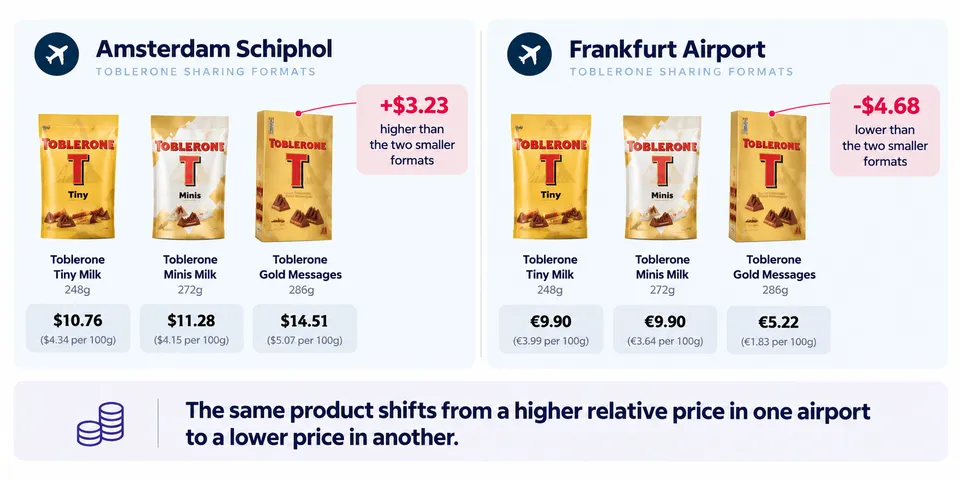
Overcrowding compounds the issue. At Frankfurt Airport, Shelftrak found 15 Toblerone tablet SKUs, including old and new pack formats, clustered around the same €9.90 price point.
This isn't simply a pricing issue; it's an assortment one. When numerous products occupy similar price points, the distinction between formats becomes less clear, raising questions about whether each SKU is earning its place on the shelf.
That is important to the Perfect Store. Price, assortment, distribution, space and promotion do not operate independently. A strong price architecture can be undermined by an overcrowded assortment, just as the right assortment can be undermined by poor pricing execution.
Shelftrak maps products against their price point, segment, brand, pack size and shelf presence, revealing whether a category provides a clear journey from entry to premium — and where execution falls short.
From execution gap to commercial opportunity
Ultimately, this is why pricing inconsistency matters. Simply identifying that a price is wrong only gets a brand so far. The more valuable question is: which execution gaps represent the greatest commercial opportunity?
Not every gap is equally important. An isolated discrepancy on one SKU is very different from an underpricing issue replicated across thousands of facings. For brands operating across multiple airports and markets, understanding that distinction is essential to deciding where action could deliver the greatest return.
This is where Shelftrak's Perfect Store framework and Size of the Prize modelling come together. By identifying where execution falls short and quantifying the potential commercial value of correcting those gaps, brands can move beyond simply recognising pricing problems towards prioritising the opportunities that matter most.
This isn't about enforcing uniform global pricing — regional cost structures, regulation and commercial positioning will always create legitimate variation. The challenge is distinguishing that variation from drift, particularly as competitors reposition and new products enter the market.
Retailers hold the final decision on shelf price, but brands have a critical role in shaping that architecture through benchmarking, competitive context and evidence of where change could create value.
For brands, the opportunity is significant. As Shelftrak's analysis demonstrates, seemingly small pricing discrepancies can represent substantial commercial value when replicated across products and stores.
The real cost of poor pricing execution isn't the inconsistency itself. It's the revenue brands risk losing, the margin they could be missing and the opportunities that remain invisible until someone measures them.
Shelftrak Inside Trak Newsletter
Retail execution trends, analysis and data-led intelligence delivered straight to your in-box
Get the latest news and commentary on pricing, compliance, shelf visibility, and execution trends driving category and channel growth worldwide.
· Zero spam · Unsubscribe at any time
Related Reading
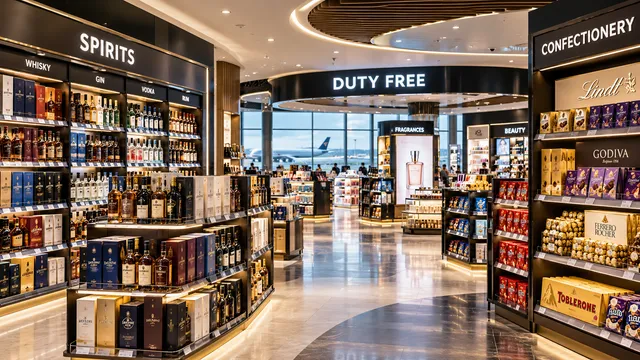
9 October 2026
Travel RetailMoney Left on the Shelf
Shelftrak quantifies the commercial value of execution gaps, helping brands prioritise opportunities across space, distribution, price and promotion.
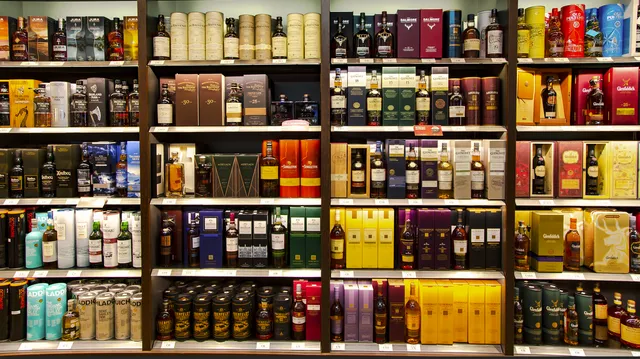
12 June 2025
Travel RetailIndia’s Whisky Wall: What 70% Shelf Space Says About Alcohol Strategy in Indian Travel Retail
Whisky commands over 70% of alcohol shelf space in Indian travel retail, shaping shopper perception and leaving other categories fighting for visibility.

7 May 2025
Travel RetailThe Price of Travel Retail: Why Pricing Competitiveness is Crucial in Today’s Market
As the global economy faces turbulent times, pricing and price competitiveness is critical for ensuring sustainable growth in travel retail.