

For too long, travel retail has expanded ranges without a clear enough strategy for curating the offer. More listings have too often been treated as progress, without the same discipline around what should come out, which shopper needs each SKU serves or how much space it needs. We need to apply that discipline to the whole range, so that expansion improves the offer rather than simply making it bigger.
Range rationalisation should make travel retail more exciting and easier to shop. It is not about stopping innovation or stripping newness out of the offer. It is about curating a range in which best sellers have the space they need and new products and brands have a real opportunity to be discovered.
Newness is essential to that ambition. It brings excitement, gives returning travellers something different to explore and helps invigorate the category. Removing SKUs that are no longer working creates the capacity to support it properly. The aim is a relevant, shoppable offer, with enough room for dependable favourites and the discoveries that could become tomorrow's best sellers.
Heinemann is putting this thinking into practice. In her July 2026 interview with Peter Marshall on TRunblocked, Chief Commercial Officer Inken Callsen explained why the retailer was becoming tougher on delisting: “we have so many new things we want to bring in and we need space for that.” Removing products that add too little gives the offer room to evolve.
In Heinemann's 2025 annual report, Callsen describes the move from broad assortments towards more curated ranges, with greater clarity around luxury, niche brands, travel exclusives and accessible entry formats. Chief Sales Officer Florian Seidel reports that the Berlin assortment pilot delivered higher sales and lower inventory with fewer items.
Reporting from Heinemann's May 2026 annual press conference, The Moodie Davitt Report noted that the retailer had cut close to 10% of its ranges over the preceding year, led by spirits and beauty. The emphasis was on a more relevant offer, supported by clearer value propositions.
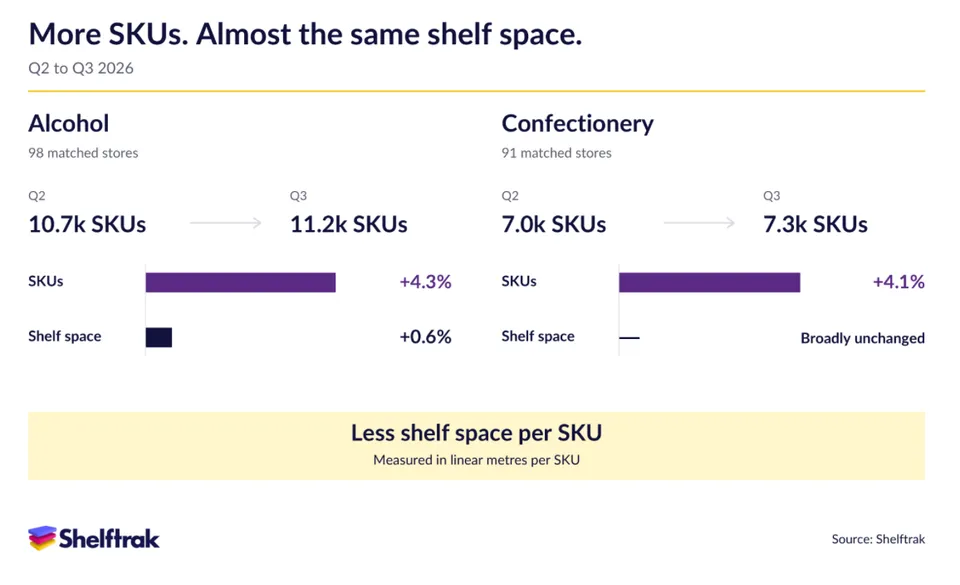
The latest Shelftrak data shows why this matters. Across 98 matched alcohol stores, the number of distinct recorded SKUs increased by 4.3% between April and August 2026, while total measured product shelf space grew by just 0.6%. Across 91 matched confectionery stores, distinct SKUs increased by 4.1%, with shelf space broadly unchanged.
Alcohol's recorded range grew from 10,741 to 11,208 distinct SKUs across the matched network. Confectionery increased from 6,968 to 7,256. These are network-wide counts, including pack variants, rather than average store ranges or counts of new launches. They show a broader offer competing for almost the same overall shelf allocation.\
Our audit measures the physical shelf; it does not establish a sales or conversion loss. It does show why range and space need to be reviewed together. As listings grow, are best sellers losing facings? Can shoppers find the core lines? Do new products have enough visibility to attract attention? Adding a launch to a crowded shelf is only the start of giving it a chance to succeed.
There is a practical reason to ask. In its 2022 article on category management, NielsenIQ warns that “overcrowded shelves can reduce visual clarity for shoppers”. More products can make an offer harder to understand, particularly when the differences between them are small.
That matters in an airport. A traveller looking for a familiar bottle, a gift within a particular budget or something distinctive from their destination needs to understand the offer quickly. A wide range has value when its structure helps them do that. If every option appears equally important, the shopper has to do more of the work. A listing tells us that a product is present. Its facings, position and surrounding products tell us much more about its chance of being found.
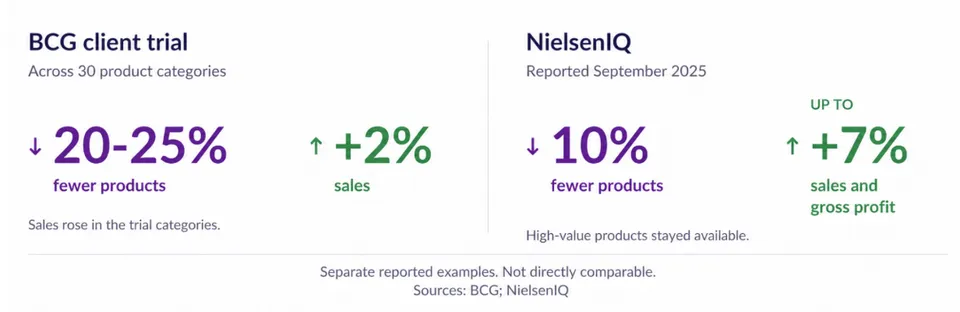
The commercial evidence for improving the range is encouraging. In its work on grocery simplification, BCG describes how excessive range leaves “less space for staples that drive sales”. It also reports a client trial in which removing 20–25% of SKUs across 30 categories increased sales by 2%.
More recently, NielsenIQ reported in September 2025 that retailers using its assortment solution achieved up to 7% increases in sales and gross profit while streamlining their assortment by 10%. Its announcement also described how the process “created space for innovation”.
Those are examples from wider retail, not forecast returns for an airport store. They illustrate a useful principle: removing unproductive duplication can release space for stronger core lines and worthwhile innovation.\
At Shelftrak, we can see how range and space can move in opposite directions. A brand can gain breadth across a store network while losing the space available to communicate that breadth. We need to understand which lines deserve more support, which additions bring something different and which existing SKUs can make way.
That requires more judgement than delisting the lowest sellers. A slower-selling product might serve a loyal shopper group, provide an important price point or meet a gifting need. A new brand will often begin from a small sales base and needs a fair opportunity to establish itself. An established SKU that adds little and consistently underperforms is a different proposition. Sales, margin, availability and shelf support should inform the decision.
NielsenIQ's analysis of incrementality describes the need for an item that “also grows your category, not one that takes away sales”. In plain terms, we need to understand how much demand a product adds and what would happen if it disappeared.
For travel retail, I would give every product an explicit job: a dependable core seller, an accessible entry point, a credible trade-up, a distinctive gift or an opportunity for discovery. Several products can share a role, but their differences should matter to the shopper. Where they repeatedly answer the same need without adding demand, we should examine whether that space could work harder for a best seller or a new brand.\
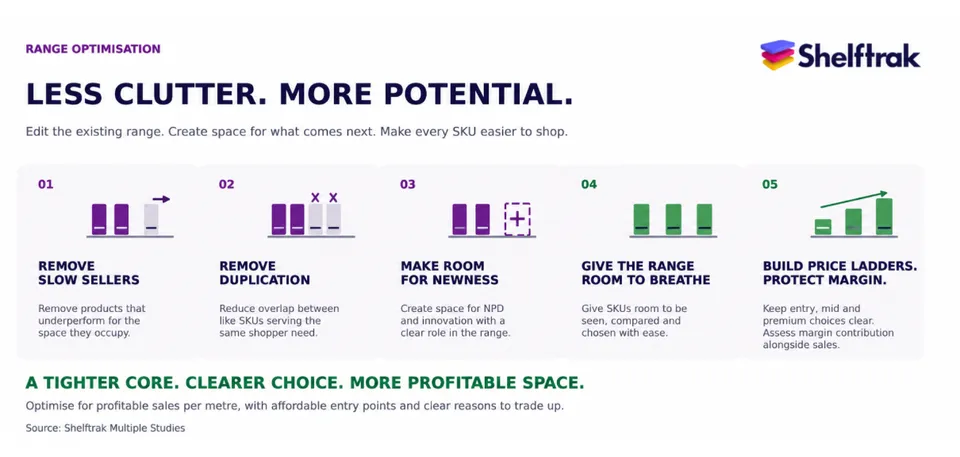
A smaller range is therefore one possible result of optimisation, not the objective in itself. Travel retail needs to stop treating assortment expansion as progress. The objective should be to offer the right products, with enough space to make them relevant, visible and commercially productive.
Heinemann's Commercial Effectiveness Manager Oliver Kreft made a useful distinction in The Moodie Davitt Report's June 2026 interview. He illustrated how an assortment review might recommend removing part of a store's skincare offer while also adding products from the group's wider database. His example describes selection in both directions. Rationalisation can make space for products that are missing locally as well as remove those that are not earning their place.
A range review should therefore include a deliberate plan for newness. Decide which new brands and products can refresh the category, then give them a defined place, adequate visibility and a clear explanation of their benefit. Simply squeezing another pack into a crowded fixture risks weakening both the launch and the products around it.
Heinemann's Test & Learn approach shows how that commitment to newness can work. The retailer described testing independent beauty brands for four to six months, with the approach also applied to liquor, tobacco and confectionery. Callsen put the ambition plainly: “We have to open the door to newness, or the assortment does not change.”
Circana's March 2026 article on SKU rationalisation captures the balance well: “leaving room for the innovation that captures new buyers”. It warns that focusing exclusively on efficient core products can make a business less relevant to shoppers seeking something new.
For our channel, that could mean an emerging brand with a distinctive story, a travel exclusive with a clear point of difference, or a gifting format for an underserved budget. Such additions can bring energy and discovery to the store. Curating them means matching the opportunity to local demand and giving them enough space for shoppers to notice and understand them.
Newness also needs substance. In Innovation under pressure, published in January 2026, NielsenIQ states: “Portfolio fragmentation continues to dilute velocity and category clarity.” It recommends fewer, stronger innovation bets with benefits shoppers can recognise. Its 2025 Innovation Vitality findings reinforce that point: brands investing in true innovation were twice as likely to achieve overall sales growth, distinguishing this from simply adding varieties or pack sizes. As the article puts it: “It's not enough to be new”.
I would translate this into a joint range and space review for every meaningful launch. Identify the shopper need, decide what the product adds, and agree where its space will come from. Challenge existing SKUs that repeatedly underperform or duplicate a need without adding demand. Reinvest released space in both the best sellers shoppers depend on and new brands with a credible role. Give launches enough prominence, supported by clear pricing and staff knowledge where needed.\
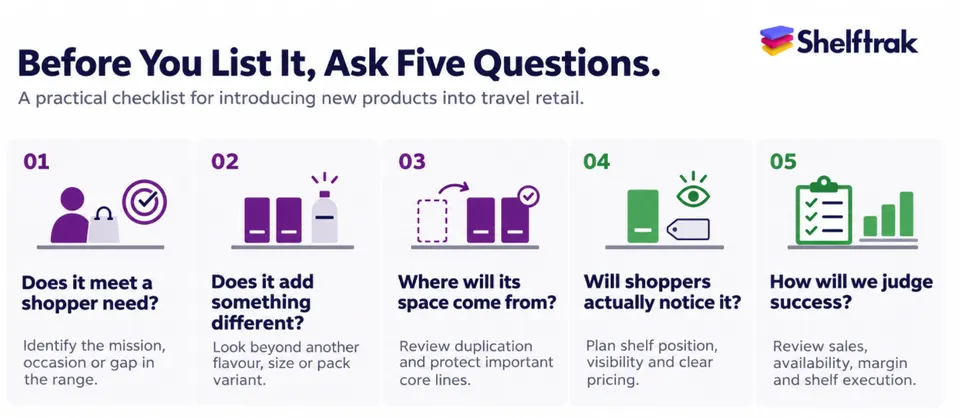
Then review the result. Combine shelf execution with retailer sales, availability, margin and shopper measures where available. Establish whether the launch adds demand, attracts different buyers or supports a valuable trade-up. Check whether it received the visibility and availability needed for a fair assessment, and whether core lines retained enough support. Agree a realistic review period and criteria for expanding, improving or removing it.
This requires local judgement. A range that works for a large departures store may be unsuitable for a smaller arrivals location. Passenger profiles, journey types, gifting missions and available space should influence both assortment and presentation. A global range list is only the starting point.
Avolta provides a complementary example of curation rather than a stated range-cutting target. Its 2025 annual report describes adapting assortments and layouts to passenger profiles and flight schedules, using curated ranges to support customer engagement and efficient use of space. It also reports expanding low- and no-alcohol ranges. The direction is relevant here: make the offer fit the traveller and retain the capacity to introduce emerging propositions.
Travel retail needs to make active curation a continuing discipline, with the whole offer reviewed as new products arrive. A successful range review should leave shoppers with an offer that is easier to navigate and still feels fresh. Best sellers need sufficient space to remain easy to find and buy. New brands and products need room to create excitement and earn their place. Removing SKUs that are not working helps fund both. That is why range rationalisation should actively enable innovation: it creates the space and attention that newness needs to succeed.
\
Shelftrak Inside Trak Newsletter
Retail execution trends, analysis and data-led intelligence delivered straight to your in-box
Get the latest news and commentary on pricing, compliance, shelf visibility, and execution trends driving category and channel growth worldwide.
· Zero spam · Unsubscribe at any time
Related Reading
12 June 2025
Travel RetailIndia’s Whisky Wall: What 70% Shelf Space Says About Alcohol Strategy in Indian Travel Retail
Whisky commands over 70% of alcohol shelf space in Indian travel retail, shaping shopper perception and leaving other categories fighting for visibility.
10 November 2026
Travel RetailTravel retail celebrates discovery. But are new brands actually being discovered?
Travel retail celebrates discovery, but are new brands actually being noticed? Shelftrak reveals the gap between securing a listing and reaching shoppers.
22 October 2026
Travel RetailBeyond the bottle: Alcohol at Cannes 2026
From bold flavours to immersive experiences, Cannes 2026 showcased alcohol innovation. But is the airport shelf keeping pace?