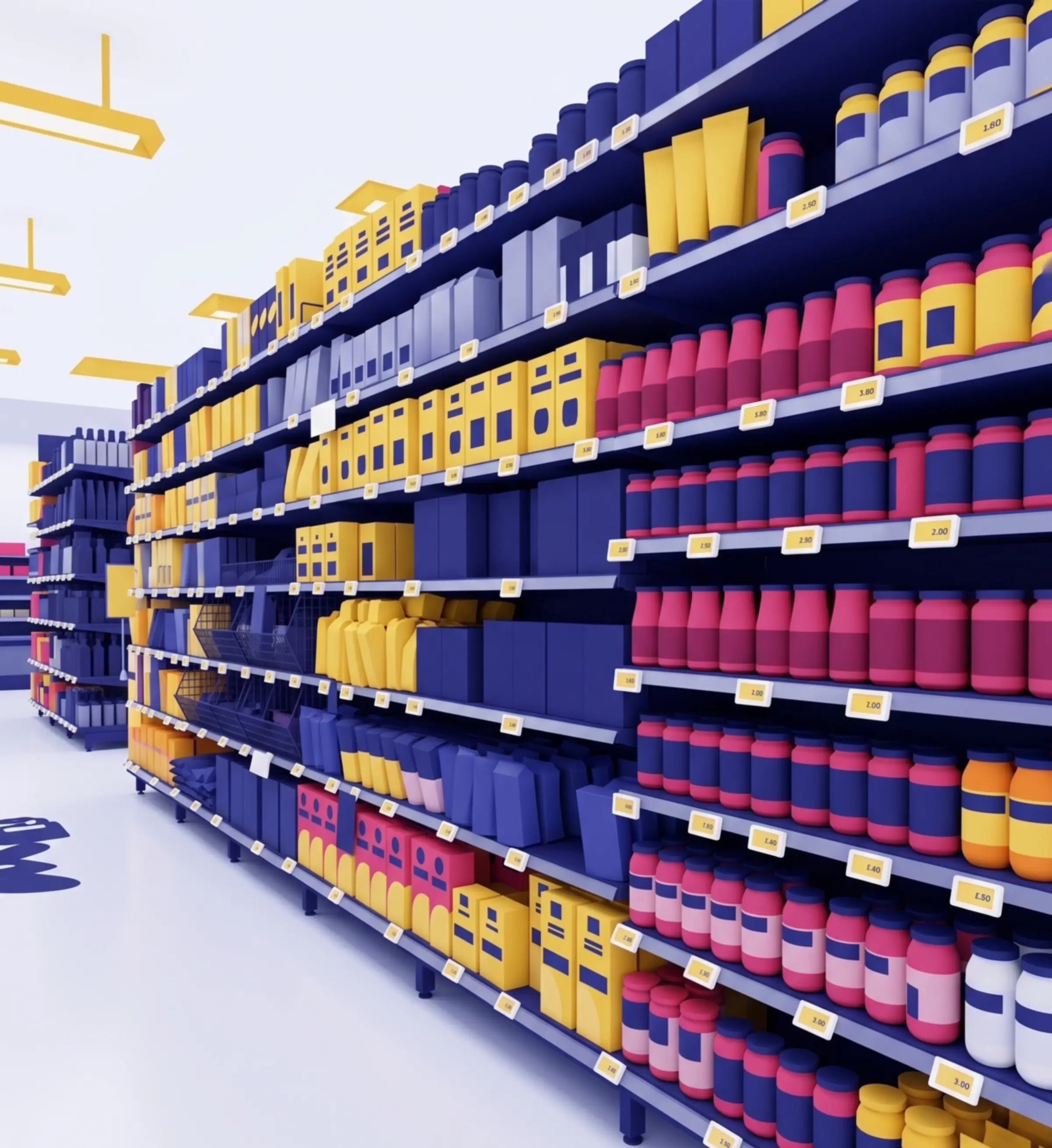

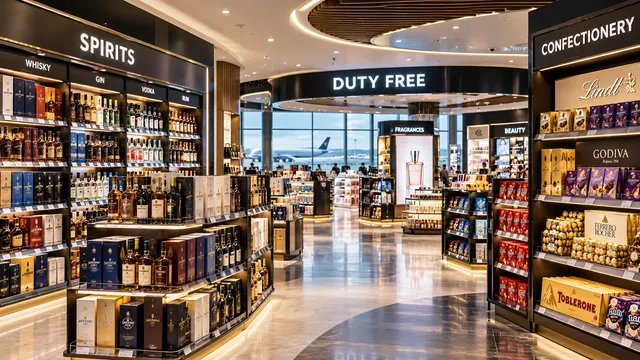
As travel retail assortments expand, brands are competing for increasingly constrained shelf space, putting pressure on individual product allocations.
Between April and August 2026 (Waves 9 and 10), Shelftrak data revealed that distinct SKUs increased by 4.3% in alcohol, while shelf space grew by just 0.6%. In confectionery, distinct SKUs increased by 4.1%, while shelf space remained broadly unchanged.
Product breadth is growing far faster than the space available to accommodate it.
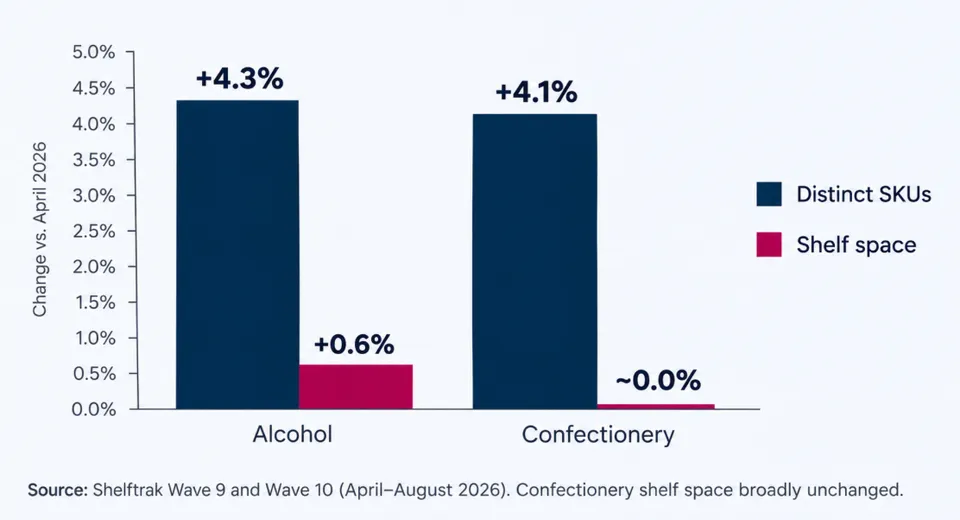
New listings may improve choice, but when shelf space fails to keep pace, fixtures risk becoming increasingly congested, leaving individual products with less room to stand out. Crowded shelves can also complicate navigation, making it harder for shoppers to find and compare products.
For brands, the question is no longer simply whether their products are stocked, or even how much space they can secure. It is whether their existing shelf allocation supports their commercial priorities — and where additional space is genuinely justified.
So, where should brands start?
Step 1: Understand your current space allocation
Before making decisions about shelf space, brands need a clear picture of what they already occupy.
This means measuring space across individual stores, airports and retailers, rather than relying solely on network-wide totals. Comparing allocations between comparable locations, particularly within the same retailer, can reveal significant inconsistencies.
Brands should also benchmark their position against competitors and the wider category to understand whether their share of shelf reflects their commercial priorities.
Shelftrak's store-level space measurements and benchmarking provide this visibility, helping brands identify where allocations may be falling short and where further investigation is warranted.
Step 2: Make existing space work harder
Securing more space is not always the first answer. Brands must first examine how effectively their existing allocation is being used.
· Are strategically important products receiving sufficient room?
· Are fixtures becoming overcrowded?
· Has the introduction of additional SKUs reduced the space available to established products?
These questions are particularly important as assortments expand. Adding products without reconsidering existing allocations can create congestion, weakening the presentation of both new and established SKUs.
Brands should review space at SKU level, considering each product's commercial role and whether its allocation reflects its importance within the range. Core products may require sufficient space to maintain a strong presence, while innovations need enough room to be discovered without unnecessarily compromising established products.
Where space is being spread too thinly, rebalancing allocations or rationalising the assortment may be more effective than expanding the fixture.
Shelftrak's SKU-level measurements of facings and linear space help brands identify where allocations may be disproportionate to their priorities, providing evidence to support decisions about how existing space could be redistributed.
The objective is not simply to fit more products onto the shelf, but to make the space already secured work harder.
Step 3: Identify where additional space is justified
Once existing space has been reviewed, brands can identify where additional allocation is warranted.
The strongest opportunities are not necessarily the stores with the smallest displays. They are locations where the brand's current allocation falls below a relevant benchmark, taking account of the retailer, category and comparable stores.
Shelftrak's Perfect Store analysis helps quantify these gaps and identify priority locations, giving brands an evidence-backed case for additional space in retailer discussions.
Rather than making broad requests for more shelf space, brands can approach retailers with specific locations, measurable gaps and a clear rationale for change.
Step 4: Look beyond the permanent shelf
Permanent shelf allocation is only part of a brand's physical presence. Secondary displays, promotional fixtures and other in-store placements can provide additional opportunities to strengthen brand visibility.
Brands should assess their share of these spaces, how consistently they are represented across stores and whether additional placements would support their commercial priorities.
As with permanent space, the objective should not simply be to secure more. It should be to identify where additional allocation has a clear purpose and can be effectively executed.
What should brands measure?
Three measures are particularly useful when assessing shelf-space opportunities:
- Share of shelf: The proportion of category shelf space occupied by the brand.
- Space gap: The additional allocation indicated by relevant benchmarks, distinguishing space associated with missing listings from the net opportunity to secure more space.
- Secondary display share: The proportion of category secondary display space occupied by the brand.
The commercial significance of these measures becomes clear when applied across a retail network.
In a recent Shelftrak Perfect Store analysis for an anonymised alcohol brand, approximately 620 metres of gross space gap were identified, revealing two distinct opportunities.
Around 120 metres were associated with missing product listings, highlighting locations where the brand could strengthen its distribution. The remaining 500 metres represented a net additional space opportunity, identifying where current allocations fell below relevant benchmarks and providing an evidence-backed case for increasing the brand’s share of shelf from 17.1% to 19.0%.
Together, these space and distribution opportunities represented an estimated $11.3 million in modelled commercial potential.
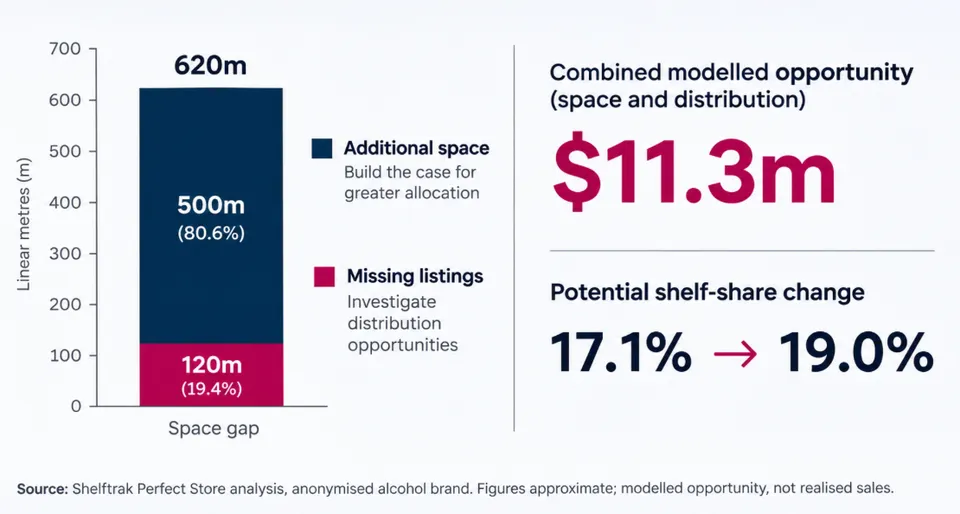
Rather than simply recommending more space, Shelftrak's analysis helps brands distinguish between opportunities to expand distribution and those requiring additional shelf allocation — and prioritise the appropriate action for each.
Space doesn't work in isolation
Securing the right shelf allocation is an essential part of effective retail execution, but space alone cannot create the perfect shelf.
The right products must occupy that space. They must be available in the right stores, supported by appropriate pricing and promotions, positioned effectively and displayed in line with agreed plans.
This is the principle behind Shelftrak's Execution Playbook: four pillars, seven guides, one "perfect" shelf.
Across the series, we will explore how brands can strengthen each execution lever and bring them together to build a more effective in-store presence.
The Execution Check
Every brand should be able to answer three questions:
- Do you know your share of shelf across priority stores and retailers?
- Can you identify where your current allocation may be insufficient or poorly utilised?
- Do you have the evidence to justify additional space in retailer discussions?
Shelftrak's Perfect Store programme helps brands answer these questions, benchmark their current shelf-space position and quantify opportunities for improvement.
Discover where your brand could be winning more space — and build the evidence to support your next retailer conversation.
Shelftrak Inside Trak Newsletter
Retail execution trends, analysis and data-led intelligence delivered straight to your in-box
Get the latest news and commentary on pricing, compliance, shelf visibility, and execution trends driving category and channel growth worldwide.
· Zero spam · Unsubscribe at any time
Related Reading

18 October 2026
Travel RetailTFWA Cannes 2026: Beauty is getting smarter. Can the shelf keep up?
From clinical skincare to AI-powered experiences, TFWA Cannes 2026 revealed how beauty is evolving and why effective shelf execution matters more than ever
9 October 2026
Travel RetailMoney Left on the Shelf
Shelftrak quantifies the commercial value of execution gaps, helping brands prioritise opportunities across space, distribution, price and promotion.

7 October 2026
Travel RetailTravel retail’s hidden opportunity
Before travel retail finds new ways to drive conversion, could fixing the execution gaps already costing millions be the place to start?